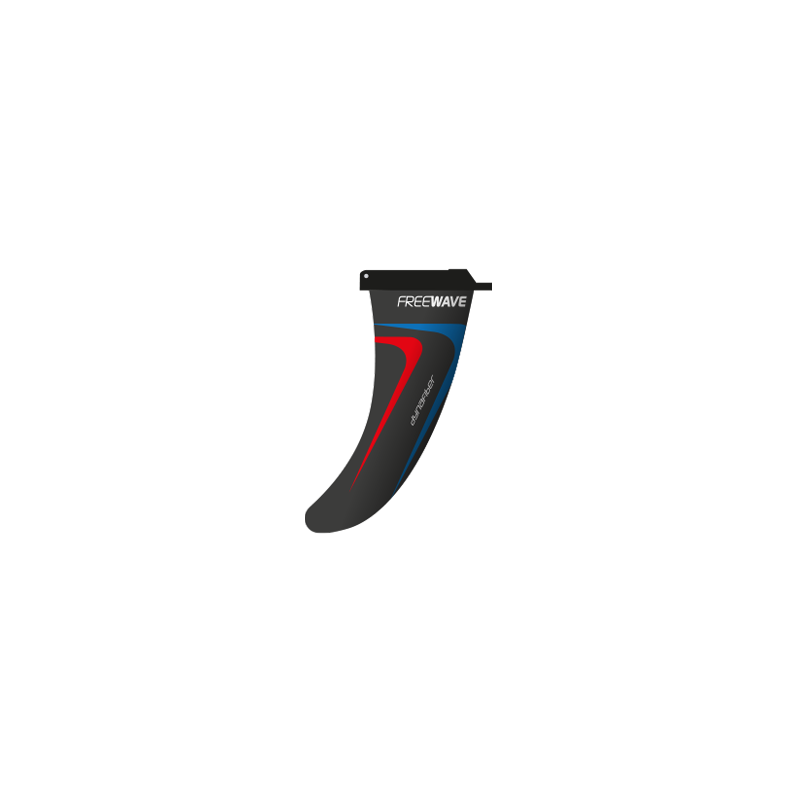

The Dynafiber Freewave Vinylester Fin is a versatile hybrid fin designed for sailors who want a "do-it-all" setup. It sits perfectly between a pure wave fin (which is very curved) and a freeride fin (which is straighter and faster), making it the ideal choice for bump-and-jump conditions and high-wind blasting.
For the 2025/2026 seasons, this fin is often chosen as the primary single-fin upgrade for modern "Freewave" or "Freemove" boards.
The shape is specifically engineered to handle two different worlds:
Wave Side: The tip has more curve than a freeride fin, which allows the board to turn more easily on a wave face or during a carving jibe.
Freeride Side: The base is wide and the profile is relatively thick, providing the "lift" and "drive" needed to get the board planing early and to cruise through lulls without losing speed.
Acceleration: The leading edge is designed for quick acceleration, helping you get up to speed fast enough to hit a ramp for a jump.
As with the other Dynafiber fins in this range, Vinylester is used to provide a specific balance of feel and cost:
Super Rigid yet Flexible: It is stiff enough to hold a high-speed line without the "wobble" of plastic, but it has enough "active flex" in the tip to prevent spin-outs in choppy water.
High Impact Resistance: Freewave sailing often involves shallow water or rocky entries. Vinylester is incredibly tough and easy to repair with a simple file if you get a "ding."
Cost Advantage: It offers roughly 90% of the performance of a G10 fin for a significantly lower price (typically around €85–€97).
| Feature | Details |
| Material | High-density Vinylester |
| Box Types | Available in Power Box (PB) and US Box |
| Sizes | Typically ranges from 23 cm to 32 cm |
| Best Conditions | Choppy water, small waves, and high-wind freeriding |
| Sail Range | Ideal for sails from 4.2m to 6.2m |
Power Box (PB): Usually found on larger Freewave boards (95L–115L) and "Freemove" boards. It uses a single bolt from the top.
US Box: Often found on smaller, wave-oriented boards. This allows you to move the fin forward (for better turning) or backward (for more speed/stability).

Specific References