
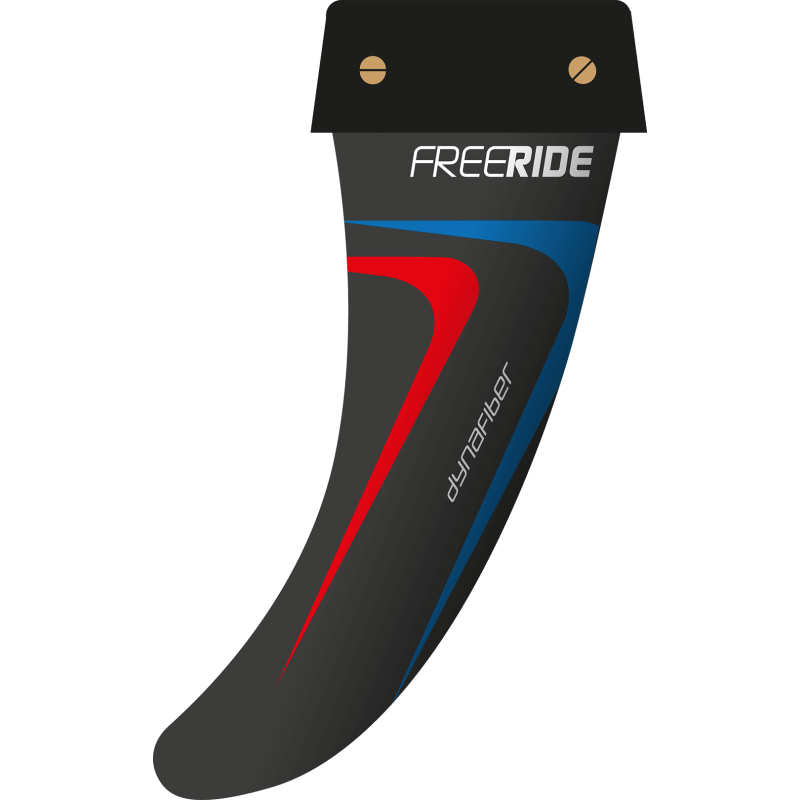

The Dynafiber Freeride Fin is a classic "all-arounder" designed to provide stability, easy planing, and forgiving control. It is a popular choice for recreational sailors who want a reliable, performance-oriented fin without the high cost of full carbon.
Here is the breakdown of the 2025/2026 Freeride PB model:
Unlike basic plastic fins, this model is made from Vinylester.
Stiffness: It is significantly more rigid than plastic, which helps the board get on a plane faster and hold a better line upwind.
Durability: Vinylester is highly resistant to impact and abrasion. If you nick a rock or sandbar, it can be easily sanded back to shape, unlike G10 which can sometimes delaminate or carbon which is very brittle.
Flex Pattern: It features a "progressive flex" at the tip. This acts like a shock absorber, preventing spin-outs by bleeding off excess pressure when you hit a gust or push too hard on your back leg.
Modern Profile: The fin has a generous surface area at the base for early planing and a swept-back (raked) leading edge.
Maneuverability: The slight curve makes jibing much smoother and more intuitive than a vertical slalom fin.
| Feature | Details |
| Material | High-Grade Vinylester |
| Box Type | TT BOX |
| Sizes | Available from 28 cm to 44 cm (usually in 2 cm steps) |
| Ideal Use | Freeride, Bump & Jump, and Lightwind blasting |
| Compatibility | Best paired with no-cam or 2-cam freeride sails |
To choose the right length for this fin, you can use the common freeride formula:
Fin Size (cm) ≈ (Board Width in cm × 0.6) — then adjust slightly for your sail size.
Small (28–32cm): Best for high winds and boards around 90L–105L.
Medium (34–38cm): The "sweet spot" for 110L–130L boards and 6.0m–7.5m sails.
Large (40–44cm): For light wind, large boards (140L+), and sails up to 8.5m.
It is the perfect replacement for the "stock" fin that comes with most boards. It offers a significant upgrade in speed and "lift" compared to plastic fins, but it is much more durable and affordable than a racing G10 or Carbon fin.

Specific References